
Narrow Lot House Plans:
Premium Linear Designs for Challenging Plots
Modern house plans designed for narrow and elongated plots
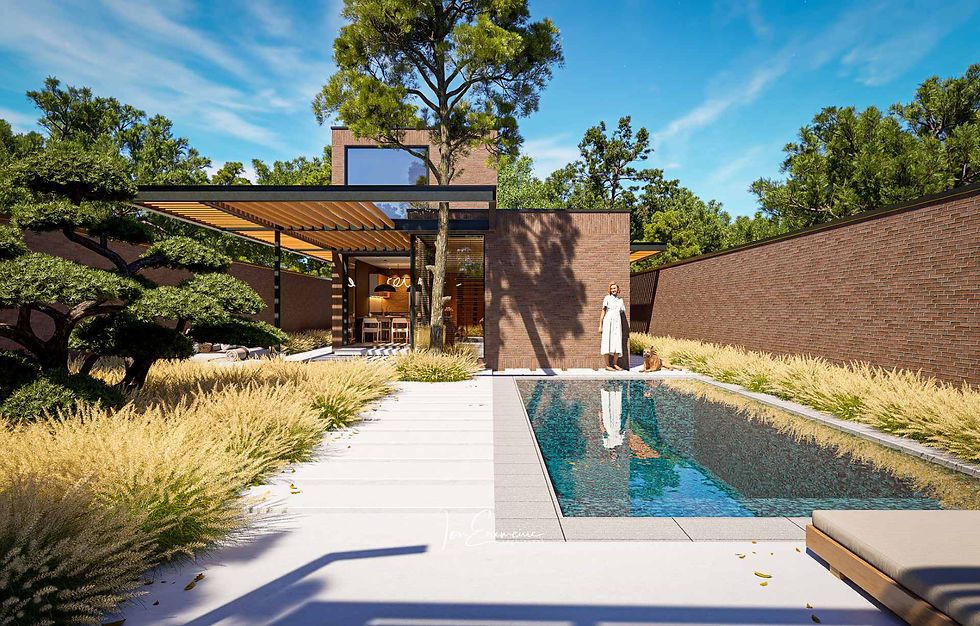


Discover a curated collection of narrow lot house plans developed to transform spatial constraints into refined architectural solution. Whether for compact plots or elongated sites, these linear designs prioritize natural light, privacy, and a fluid connection between spaces.
At 12 House Concepts, each project is carefully designed to avoid the limitations of standard narrow layouts, creating open, balanced interiors with a strong architectural identity. These plans offer flexible solutions adaptable to a wide range of site conditions.


The Logic of Design: How our Narrow Lot House Plans Are Optimized
The Architecture of Perspective - The logic behind
Building on a restricted lot or a dramatic landscape requires more than just a floor plan, it requires a strategic response to site constraints. At 12 HC by Ion Eremciuc Architects, our concepts are engineered to solve the three primary challenges: light, flow and privacy.
1. Maximizing the View-to-Space Ratio
One of the key advantages of linear narrow lot house plans is the ability to maximize the relationship between interior spaces and the surrounding environment. By stretching the floor plan along the site's axis, we ensure that every bedroom and the main social area face the primary view - be it a curated urban garden, a coastal horizon or a mountain range.

2. The Science of Natural Light in Narrow Envelopes
Designing for narrow plots requires a careful approach to daylight distribution, especially in elongated floor plans where central areas can became darker. To address this, narrow lot house designs often incorporate clerestory windows, skylights and strategically placed openings that bring natural light deep into interior.
In some cases, internal courtyards or light wells are introduced to enhance brightness and ventilation, ensuring that all areas of the house remain comfortable and visually open, even between compact building envelopes.
3. Privacy, Acoustic & Functional Zoning
Privacy in a narrow or long home is often difficult to achieve. Our logic relies on Sequential Zoning. We use buffer spaces: "service nodes" - like bathrooms, laundries, pantries, or storage walls - as acoustic buffers between the high energy social zones and the quite sleeping quarters. Alternatively, vertical organization allows bedrooms to be placed on upper levels, improving privacy while maximizing the efficiency of the layout.
The 12HC Delivery - From Vision to Construction
Our projects are developed through a structured two-step process, allow you to first to understand the architectural intent and spatial experience, and then move seamlessly toward technical implementation.
1. The Concept Package: Experience Your Future Home
The Concept Package focuses on architectural idea and spatial clarity of the project. It provides a complete visual and technical overview, including fully dimensioned floor plans, sections, elevations, high-quality renderings and Immersive Walkthroughs.
2. The CAD Version (DWG Files): The Professional Package
The CAD version extends the project into fully adaptable technical framework. Delivered as editable DWG files, it enables local architects and engineers to refine the design according to site conditions, structural requirements, and regional building regulations.
This approach ensures a clear transition from architectural vision to buildable solution, maintaining design integrity while allowing precise technical adaptation.

Frequently Asked Questions About Narrow Lot House Plans
1. What is considered a narrow lot?
A narrow lot has typically limited street frontage, usually between 30 and 50 feet (9-15 m), requiring efficient and compact house design. In some cases, this condition also appears on irregular or atypical plots with an elongated, linear configuration.
2. Are narrow lot house plans suitable for urban areas?
Yes, narrow lot house plans are ideal for areas with limited frontage, offering efficient layouts within compact plots. They are commonly used in urban settings but can also adapt well to suburban or irregular sites.
3. Is a two-story house better for a narrow lot?
In many cases, a two-story house is more efficient for a narrow lot, as it maximizes space through vertical development while keeping a compact footprint. However, single-story narrow lot house plans offer better accessibility and a more seamless indoor-outdoor flow.
4. How do narrow lot house plans maximize natural light?
Narrow lot house plans use strategic architectural features like skylights, clerestory windows, and open-concept layouts to funnel light into the home. By incorporating glass doors and side courtyards, these designs prevent a "tunnel" feel and ensure every room feels bright and airy.
5. Can I have an outdoor living area on a narrow lot?
Yes, outdoor spaces can be integrated through terraces, courtyards, or compact backyard areas. Efficient design allows even narrow plots to include functional and comfortable outdoor zones.
6. How do you ensure privacy in a narrow lot house?
Privacy is achieved through careful layout planning, controlled window placement, and zoning of spaces. Living areas are oriented away from neighbors, while bedrooms and private zones are positioned for greater separation.
7. Can a narrow lot house work on sloped or irregular terrain?
Yes, narrow lot house plans can adapt well to sloped or irregular terrain through flexible layouts and careful site integration. Linear designs often work efficiently with the natural shape of the land, allowing better orientation and space optimization.
8. Are narrow lot house plans more expensive to build?
Not necessarily. While some narrow lot house plans may require more precise planning or site adaptation, their compact footprint can help optimize construction costs. When well designed, they offer an efficient and cost-balanced solution.